
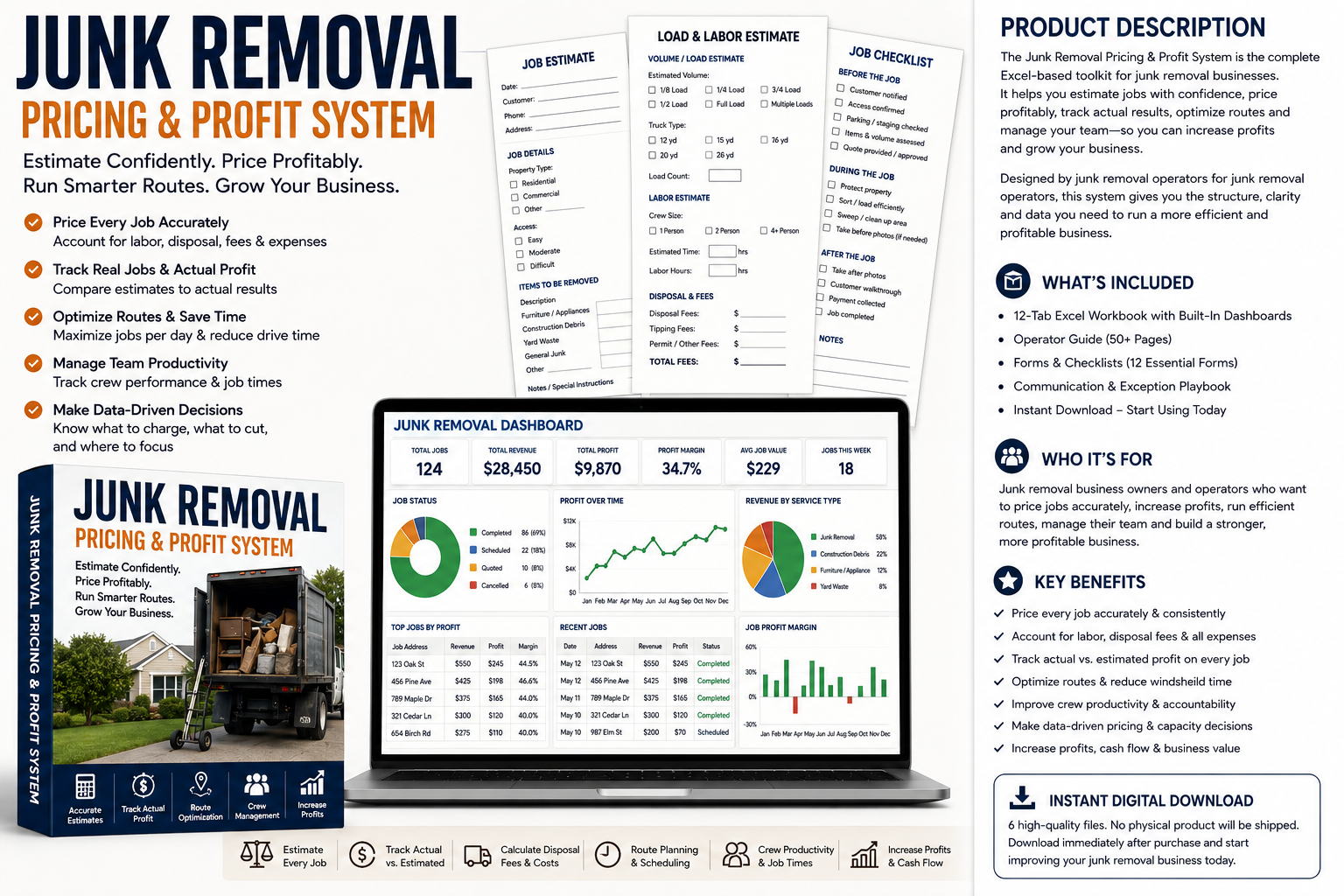
Junk Removal Quote & Load Profitability System
Instant delivery. Your download link is on the confirmation page and in your email.
Editable working files, not a video course.
Opens on desktop, tablet and phone.
Secure checkout, handled by Shopify.
Junk Removal Quote & Load Profitability System
A complete quoting, load-estimating, disposal-cost, and job-profitability toolkit built for junk-removal and cleanout businesses.
A pile of junk can look simple in a photo and become a completely different job once the crew arrives.
The load may take more truck space than expected. Dense material may cost more to dispose of. A couch may be on the third floor. The basement may contain twice as much material as the customer photographed. The nearest disposal facility may not accept an item. One additional dump cycle can disrupt the rest of the day.
The Junk Removal Quote & Load Profitability System gives operators a structured way to price those realities before they become expensive surprises.
It combines truck-volume estimating, labor, disposal, access, mileage, special items, quote confidence, scope-change control, actual job costing, and estimate calibration into one operating system.
Price the Complete Job
Build the internal quote from the costs the business will actually carry.
The system accounts for truck volume, crew size, onsite labor, drive time, disposal cost, special-item fees, dump cycles, vehicle burden, overhead, minimum charges, and target margin.
The result is a modeled internal price built from the operator's own economics.
The customer does not need to see that entire cost model.
Once the scope is confirmed, the system is designed around presenting one clear approved total for the agreed work.
Estimate Truck Space Consistently
Set the usable capacity of your actual truck or trailer and create repeatable load tiers such as minimum, one-eighth, quarter, half, three-quarter, and full load.
Each job records both:
Estimated truck share
and
Actual truck share
That makes visual estimating measurable.
Instead of simply thinking, “I am getting better at quoting,” the operator can see whether estimates are systematically running high or low.
Use Quote Confidence
Not every photo estimate deserves the same level of commitment.
The system classifies quotes as High, Medium, or Low confidence based on how complete the available job information is.
A clearly photographed curbside pile with normal access can support a stronger remote estimate.
A basement cleanout with partial photos, unknown rooms, dense material, stairs, or uncertain disposal requirements should be handled differently.
The system can recommend:
Remote conditional quote
Confirm onsite before loading
or
Onsite assessment recommended
This gives the operator a practical way to avoid pretending an uncertain job has an exact known price.
Separate Volume From Weight Risk
Truck space does not tell the whole story.
Furniture and bagged household junk may consume considerable volume without behaving like concrete, tile, dirt, or other dense material.
The system keeps load volume and weight/disposal risk separate so heavy debris does not quietly move through ordinary household-junk pricing.
Build a Local Disposal Catalog
Track the actual disposal and recycling paths used by the business.
Record business cost and customer charge separately for categories such as mixed household junk, mattresses, appliances, tires, electronics, dense debris, and other special items.
Restricted or uncertain materials can be marked:
Accept
Verify
or
Refer
This helps the operator stop and verify the disposal path instead of inventing a surcharge onsite.
Control Scope Before Loading
A major part of junk-removal pricing happens at the moment the crew sees the real job.
The included scope-control process compares the approved quote with the actual onsite volume, material, access, and special items.
If the job materially differs, the operator can document the change, calculate the revised total, explain it to the customer, and obtain approval before the additional material is loaded.
The package includes a dedicated Scope Change Authorization form and customer messages for exactly this situation.
Customer Quote Summary
The workbook includes a clean Customer Quote view that separates the internal pricing model from the customer-facing decision.
It displays the customer, estimated load, quote confidence, recommended quote method, approved total, material/scope, access notes, special items, quote status, and validity period.
It also includes the operating rule behind the quote:
Present one clear total for the approved scope. If the onsite volume, material, access, or special items materially differ, stop before loading, explain the change, and obtain approval for the revised price.
Track Actual Job Profitability
After the job, record what really happened.
Track actual load share, crew hours, drive time, dump cycles, mileage, disposal charges, specialty fees, final revenue, and company-owned damage or rework.
The system calculates:
Total variable cost
Job contribution
Margin
Contribution per truck hour
This helps distinguish a job that produced a large invoice from a job that used truck and crew capacity efficiently.
Calibrate Your Estimates
Every completed job becomes estimating data.
The Calibration Review compares:
Quoted load vs actual load
Quoted labor vs actual labor
Quoted disposal vs actual disposal
It then identifies the primary estimating lesson.
A garage pile may be stable.
An estate cleanout may repeatedly miss on volume.
A basement job may repeatedly miss on labor and access.
That gives the business a concrete reason to change the intake or quoting process for that type of job.
Manage Truck-Day Economics
Truck capacity is a time resource as well as a volume resource.
The Truck-Day system tracks crew hours, driving, dump time, mileage, revenue, disposal cost, labor cost, contribution, and contribution per truck hour.
This makes the impact of second dumps, long detours, and awkward jobs visible.
Property & Access Protection
The forms package includes a property and access check for stairs, elevators, floors, walls, doorways, landscaping, driveways, parking, and other areas that can create service risk.
If a company-owned damage or rework event occurs, the system keeps that cost separate and visible in the job economics.
Forms & Checklists
The package includes structured forms for remote job intake, load estimating, quote confidence, property/access protection, onsite scope confirmation, scope-change authorization, disposal records, restricted-material handling, job completion, incidents, estimate calibration, and truck-day review.
Communication Playbook
The customer communication pack covers photo requests, incomplete-photo follow-up, low-confidence jobs, conditional remote quotes, appointment confirmation, arrival updates, onsite price confirmation, changed scope, additional items, restricted materials, dense-material risk, additional dump trips, route delays, job completion, damage acknowledgement, estimate follow-up, reviews, and repeat work.
Built For
This system is designed for independent junk haulers, junk-removal startups, cleanout businesses, owner-operators, small crews, furniture and appliance removal services, garage and basement cleanout providers, estate cleanout operators, and businesses that want a more disciplined way to price jobs without another monthly software subscription.
Digital Download
Your purchase includes the complete six-file Operating Kits package.
Price the load. Confirm the scope. Know what the job actually made.
© 2026 Operating Kits. Licensed for use within one purchaser-operated business. Operational education only. Disposal, environmental, vehicle, hazardous-material, tax, insurance, employment, safety, licensing, and regulatory requirements vary by location.
Choose options