
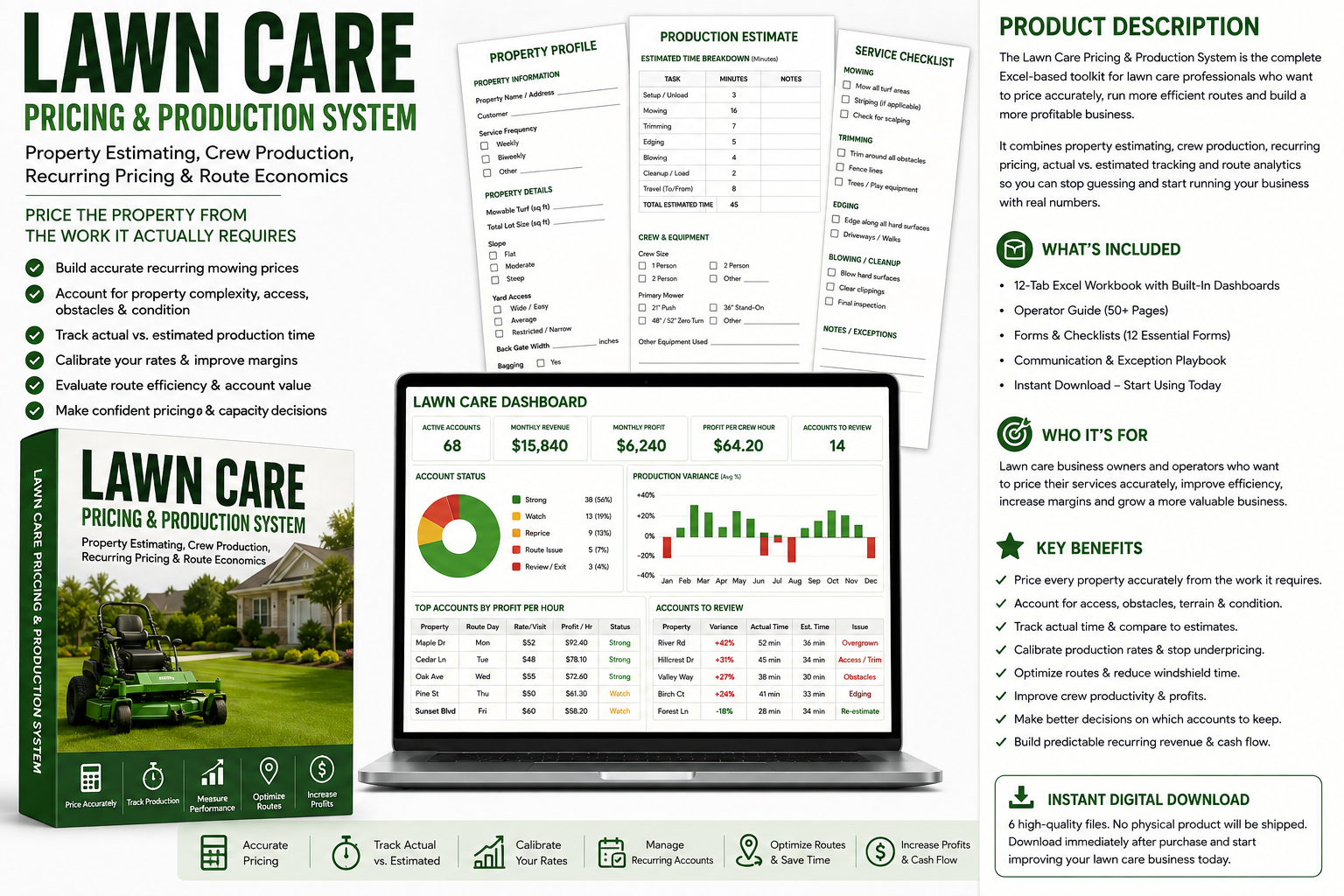
Lawn Care Pricing & Production System
Instant delivery. Your download link is on the confirmation page and in your email.
Editable working files, not a video course.
Opens on desktop, tablet and phone.
Secure checkout, handled by Shopify.
Lawn Care Pricing & Production System
A complete property-estimating, crew-production, recurring-pricing, and route-economics toolkit built for lawn-care businesses.
Square footage alone does not tell you what a lawn costs to service.
Two properties can have nearly identical turf area while requiring completely different amounts of crew time because of mower access, gates, slopes, edging, trimming, obstacles, bagging, service frequency, and travel.
The Lawn Care Pricing & Production System gives lawn-care operators a structured way to turn those production factors into an internal recurring-price model, compare quoted time with real field performance, and improve the estimate as the business completes more visits.
Instead of relying on memory or a simple price-per-square-foot formula, the system creates a feedback loop:
Measure → Predict → Price → Perform → Record → Recalibrate
What’s Included
- Lawn Care Pricing & Production Guide
- Interactive Pricing & Production Workbook
- Forms & Checklists
- Customer Communication Playbook
- Start Here Guide
- License & Use Guide
Build Prices From the Work the Property Requires
Create a production profile using factors such as:
Mowable turf area, primary mower, restricted-access turf, edging length, trimming burden, slope, bagging, recurring frequency, drive time, crew size, and current recurring price.
The system then translates the workload into expected production time and business economics.
Separate Clock Time From Labor Hours
A two-person crew finishing a lawn in 30 minutes has not consumed 30 minutes of labor.
It has consumed one labor hour.
The system keeps those two concepts separate:
Clock time measures how much route capacity the property consumes.
Crew labor hours measure how much paid labor the property consumes.
That makes crew-size decisions much clearer.
Use Production Rates Without Pretending They Are Universal
The workbook includes editable starting production assumptions for:
Open mowing, restricted mowing, push mowing, edging, string trimming, and blow-off.
These are designed to be replaced by the operator’s own field history.
The purpose is not to claim that every 52-inch mower produces the same number of square feet per hour.
The purpose is to give the business a consistent estimating framework that gets better as real jobs are completed.
Calibrate New Properties
A recurring quote can repeat dozens of times across a mowing season, so a small estimating mistake can become expensive.
New properties can begin in a Learning phase.
The system compares:
Expected service time
against
Actual average service time
Once normal visits establish a repeatable workload, the operator has a stronger property baseline.
If the actual service consistently differs from the estimate, the workbook surfaces the variance instead of letting it disappear inside the route.
Detect Pricing Drift
For each property, review:
Current recurring price, modeled price at actual production, price gap, service-time drift, drive burden, and contribution per occupied hour.
The workbook can distinguish a stable account from one that deserves a pricing review.
The output does not automatically tell the operator what to charge.
It shows the economic relationship so the operator can decide whether to maintain the price, reprice, change frequency, adjust scope, change route placement, or review the account more broadly.
Handle Weekly, Biweekly, and Overgrown Work More Clearly
Weekly maintenance and biweekly maintenance do not necessarily create the same workload per visit.
The system keeps service frequency visible in the production model and allows actual field history to show whether that property requires materially more time at a different interval.
Abnormal overgrowth can also be separated from the normal recurring baseline instead of quietly contaminating the production assumptions.
Build Minimum-Stop Economics Into Pricing
A small lawn can still be a poor stop.
Travel, unloading, equipment, setup, cleanup, and route interruption exist even when the grass takes only a few minutes to cut.
The workbook compares the modeled property economics with the business’s own minimum-stop requirement.
This keeps tiny but inconvenient jobs from being priced as if the truck appeared at the curb for free.
Measure Route Economics
The Route Planner tracks:
Service clock minutes, drive minutes, miles, crew labor, revenue, vehicle cost, equipment burden, overhead, route contribution, and contribution per route hour.
This is not GPS route-optimization software.
It answers a different question:
What is this route producing economically?
That helps identify dense, productive route days and isolated stops that consume too much windshield time.
Track Weather, Access, and Company-Owned Problems Separately
The system distinguishes between events such as:
Weather delays, customer access problems, customer-requested skips, company misses, overgrowth conditions, and quality rework.
This matters because responsibility matters.
If the company misses the agreed service and the lawn becomes harder to cut as a result, that should not automatically become a customer-paid overgrowth charge.
Review the Entire Season
The system includes a Season Value layer that keeps recurring mowing economics separate from add-on revenue.
Track expected mowing visits, recurring mowing revenue, mowing contribution, seasonal add-on revenue, total customer revenue, and contribution per occupied hour.
That means mulch, aeration, cleanup, shrubs, or other add-ons can increase customer value without being used to hide an underpriced mowing agreement.
Forms & Checklists
The package includes practical operating forms for property qualification, production profiling, recurring scope, calibration, weather/access exceptions, quality incidents, account pricing reviews, and route reviews.
Communication Playbook
Ready-to-customize messages cover new inquiries, quote delivery, calibration, weather delays, access problems, company-owned misses, overgrowth, scope changes, quality recovery, routine price reviews, property-specific repricing, route-day changes, season renewal, and service termination.
Built For
Independent lawn-care operators, mowing businesses, small crews, owner-operators building recurring routes, companies trying to improve estimating consistency, operators moving away from guess-based pricing, and businesses trying to tighten route density without sacrificing margin.
Digital Download
Your purchase includes all six customer-facing files and is licensed for use within one purchaser-operated business.
Price the property from the work it actually requires.
© 2026 Operating Kits. Operational education only. Equipment, pesticide, employment, insurance, safety, tax, legal, and regulatory requirements vary by location.
Choose options